The Dress Poshmark Never Saw
My first Poshmark purchase arrived without the tag its listing promised. The dispute led me to compare how resale platforms observe, verify, and present evidence before asking buyers to trust a listing.
Published: 2026-09-16
What Does a Marketplace Actually Know About What It Sells?
At the front door, my stomach dropped when I realized something was wrong with my first Poshmark purchase.
The label sewn into the dress's neckline said Shop Indy. There was no hang tag attached. The dress smelled strongly of perfume, and the fabric felt much cheaper than any of the FARM Rio pieces I already owned.
I had missed the FARM Rio Sicily dress when it went on sale, and by the time I went back for it, I could not find my size anywhere. Weeks later, a Google search surfaced a $50 Poshmark listing that, to me, looked exactly like the dress I had missed. I was genuinely excited to finally find it.
My first reaction was disappointment. My second was more complicated as the seller had never actually said the dress was FARM Rio. I had made that connection myself from the search that brought me there and from the photos. New With Tags, however, was written plainly on the page, and the dress in my hands had no tag.
I opened a return case within half an hour. Poshmark approved it that night. I kept thinking about what Poshmark could have known.
The Listing and the Dispute
On the listing itself, the strongest claim was condition: New With Tags. The seller repeated "new with tags" in the description. Poshmark defines NWT as a new item with the original tags still attached. Yet none of the listing photos showed a tag attached to the dress.
The listing was much less specific about brand information. The brand field was blank, and none of the photos showed the sewn-in neckline label. Because I had found the listing through a FARM Rio search and the design looked identical to me in the photos, I assumed the dress was FARM Rio.
When I opened the return case, I selected Order not as described and uploaded four photos. My first message also mentioned the resemblance to FARM Rio, which the seller pushed back on, correctly noting that she had never listed the dress as FARM Rio. I later narrowed the case to a condition discrepancy: the listing said NWT, the dress arrived without an attached tag, and it smelled strongly of perfume. The seller maintained that the tags had been attached when she shipped it.
My front-door security camera captured the sequence after delivery, from my partner opening the package through my inspection and photos at the doorway. I told Poshmark about the footage and said I had not removed the tags.
About nine hours after I opened the case, Poshmark approved the return without asking to see the video. The email classified the order as not as described and said the case had been reviewed. It did not say which fact had carried the decision.
Poshmark resolved the return without resolving whether the tag was still attached when the seller shipped it.
Two Kinds of Uncertainty
Once I looked at the case as a product problem, I realized I had been asking the marketplace to know two different things.
Condition / State
The condition dispute was time-bounded. New With Tags implies that the tag stayed attached through shipment and arrived that way. A photo can show a tag at one moment, and carrier tracking can establish where the parcel moved. Neither shows the state of the dress inside the package as it passed from seller to buyer.
In an ordinary Poshmark transaction, the marketplace has the seller's listing, carrier tracking, and whatever evidence the buyer creates after delivery. Posh Protect compares the received item with the listing description, and seller-facing guidance says case review can include the listing, buyer evidence, and messages between the parties.
The missing piece is an item-level observation between the seller's last record and the buyer's first one. I think of that gap as the platform-unobserved interval. A packing photo or video could move the seller's record closer to handoff. To close the interval with an independent observation, the platform, or a party it trusts, would have to observe the item itself.
Provenance / Identity
The Shop Indy label created a different kind of uncertainty. Nothing about it had changed during shipping. The information was physically present on the dress the whole time, yet it simply had not entered the listing.
Poshmark's older listing guidance tells sellers to leave the brand field blank when an item is unbranded. In the listing I saw, the blank field gave me no way to tell whether the item was unbranded, the brand was unknown, or the seller had simply left it unfilled.
That matters because provenance is about representing what the object is. In my case, the blank sat next to photos that, to me, looked strikingly close to a FARM Rio dress and had reached me through a FARM Rio search. The seller had made no FARM Rio claim, but the listing also gave me little information with which to correct my own inference.
Condition and provenance need different kinds of evidence: condition requires a better record of the item's state over time, while provenance requires better representation or verification of its identity.
Different Product Choices
I've shopped on quite a few resale marketplaces. Once I separated those two problems, I started to see the choices these platforms were making about when evidence gets created, who gets to create it, and what a buyer is being asked to trust before checkout.
Claim-Based C2C
Poshmark, Depop, and Mercari all use the classic C2C (consumer-to-consumer) model: one person writes the listing and ships the item directly to another. The marketplace provides the transaction layer and steps in when a dispute arises, but it normally does not inspect the item before delivery.
Depop uses a similar evidence architecture but sets a narrower boundary around what it will resolve after delivery. Its policy explicitly excludes smells from "significantly not as described" claims. The result is a lighter trust model, with fewer kinds of mismatch entering the dispute process.
Poshmark itself shows that this architecture is a product choice. Under Posh Authenticate, eligible luxury items priced at $500 or more are routed to Poshmark before delivery, where authenticators inspect details including logos, tags, and overall quality.
Transaction Authentication
That authenticator checkpoint is selective on Poshmark. Some marketplaces make it part of every transaction: the seller ships the item to the marketplace or its authentication partner first, giving the platform its own item-level observation before the item reaches the buyer.
I experienced that model when I bought a limited-edition The North Face × KAWS ski jacket on SNKRDUNK. My account showed the jacket moving from the seller to SNKRDUNK, through authentication, and then on to me only after it passed. A failed authentication would have canceled the transaction. SNKRDUNK's transaction process includes authentication before delivery. Its authentication checks cover condition as well as identity, including product tags and other item details. StockX's Verified Marketplace is a U.S. variation on the same model.
SNKRDUNK says it also retains item identifiers and video-recorded authentication process for quality assurance. The marketplace now has its own record between the seller's claim and the buyer's receipt.
Platform observation creates stronger evidence at the cost of more handling, labor, and time. For a limited-edition jacket I specifically wanted authenticated, that tradeoff felt reasonable.
Managed Resale
Managed resale moves the checkpoint earlier and changes the platform's role. The item enters the reseller's custody before the buyer-facing listing exists. The reseller can inspect its identity and condition, photograph and describe it, and then create the listing from its own observation. The buyer is relying on a record the platform wrote from its own inspection.
The RealReal and FASHIONPHILE follow this model. They invest heavily in who is qualified to make that judgment. The RealReal says it employs hundreds of experts and brand authenticators, including gemologists and horologists, and uses a brand-specific process that combines human expertise with proprietary authentication technology and a large dataset of luxury goods. FASHIONPHILE uses brand-specific authenticators trained through its internal program. It says becoming a Master Authenticator requires more than 8,000 hours of hands-on experience. Its inspection process also documents condition, repairs, materials, hardware, serial numbers, and other brand-specific markers.
I have bought from both, but The RealReal has always felt unusually tangible to me because I can walk into one of its stores. That physical presence makes it feel like a retailer standing behind the item.
Brand-Owned / Prior-Custody Resale
Brand-owned and prior-custody resale start with information that other resale platforms would have to reconstruct later. A brand already knows the identity of its own products, while a prior-custody operator may already have a record of an item's use, cleaning, repair, or return history. Some of the evidence therefore exists before the item enters resale.
Lululemon Like New reduces provenance ambiguity because every item is supposed to be this brand, even though the marketplace now includes both private sellers and lululemon-owned inventory. Crucially, lululemon-owned listings are explicitly labeled lululemon Like New, so buyers can distinguish brand-owned inventory from peer-seller listings (Like New terms). That does not eliminate condition disputes, but it makes the source of the listing clearer than on a general marketplace like Poshmark.
Nuuly's advantage comes from prior custody. Its rental inventory has already passed through the company's own system before some items move into resale. Nuuly says those items are cleaned and repaired before being sold through its own channels and sister-brand marketplaces.
Where the Evidence Comes From
A listing can look equally certain on screen even when the platform has very different evidence behind it. Putting buyer expectations next to the platform mechanism makes that gap easier to see.
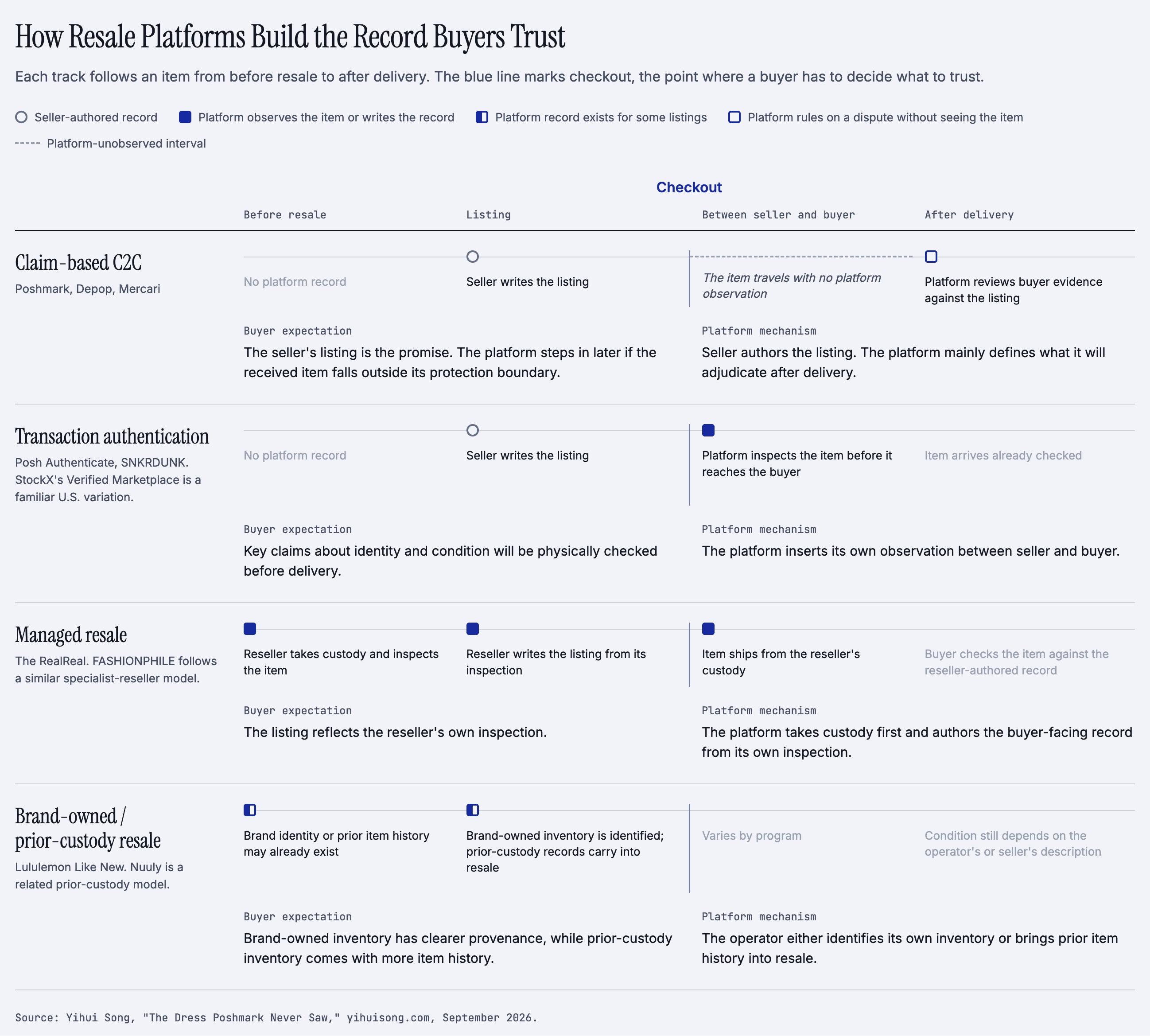
A seller-authored listing gives the platform less basis for certainty than an item it has inspected, documented, or already knows from prior custody. As the platform takes on more of that work, it also takes on more responsibility for the claims it presents. Platform-authored records create another trust problem.
When the Marketplace Writes the Record
Zhuanzhuan began as a major Chinese C2C marketplace and later built platform-run inspection services. In September 2025, it announced that it would shut down its open C2C marketplace, called Free Market, and focus on inspection-led transactions. By then, Free Market accounted for less than 3% of platform GMV. In reporting on the decision, CEO Huang Wei said the model had created room for online fraud and gray-market trades, and that the company had struggled to find a satisfactory way to improve disputes between individual buyers and sellers. The shift gave Zhuanzhuan more control over what it could observe and verify.
Once the platform makes the inspection judgment itself, that judgment can also be contested. Zhuanzhuan has faced public allegations about inconsistent inspection assessments depending on which side of a transaction it occupied. I cannot evaluate those allegations from the reporting alone, but they illustrate the limit of a platform-authored record.
Zhuanzhuan made the tradeoff clearer to me. Giving the platform more visibility can close one evidence gap, but once the platform writes the record itself, buyers have to trust that judgment instead.
A Better Trust Layer for Poshmark
That tradeoff brought me back to my $50 dress. More platform observation can create a stronger record, but an ordinary C2C purchase does not justify the same workflow as a limited-edition jacket or luxury consignment.
Poshmark can still do more before reaching that point. The confidence of a claim should better match the evidence behind it.
Capture Better Evidence
For condition claims such as New With Tags, Poshmark could ask sellers to photograph the attached retail tag when they create the listing. Although it doesn't prove that the tag was still attached at shipment, it would strengthen the record behind the claim.
Provenance needs different evidence. A seller listing a branded item could be asked to photograph the sewn-in brand label. For new branded goods, Poshmark could also let sellers provide a receipt, order confirmation, or other proof of purchase.
The brand field itself could also be more precise. A blank field like the one I saw could be replaced with explicit states such as unbranded, unknown, or not entered. That would distinguish missing information from an affirmative claim that there is no brand to report.
Vinted already takes a version of this approach. It requires sellers to choose a brand or explicitly select No brand, and for certain branded items it asks sellers to photograph details such as labels, tags, stitching, and proof of purchase. The platform still relies on seller-authored evidence, but it makes that evidence more structured before a dispute begins.
Show What the Platform Actually Knows
Better evidence only helps if the interface makes its status clear. Poshmark already does this in one narrow case. Eligible luxury listings carry an Authentication Included badge, telling buyers that the item will be authenticated after purchase and before delivery. Ordinary listings could use a lighter version of the same idea, with labels such as seller-asserted and platform-verified to make clear what comes from the seller and what Poshmark has checked.
New With Tags appeared as a definite claim even though Poshmark had never observed the tag. The brand field appeared simply blank even though that absence could mean several different things. Poshmark did not need to inspect a $50 dress to make those differences clearer.
Knowing Enough to Make a Promise
By the end of the case, my return was approved, but what happened to the tag before shipment was still unresolved.
No marketplace can observe everything about every item, and it should not try to. But every claim a platform presents creates an expectation. The more certain the interface looks, the stronger the evidence behind it should be. Otherwise, uncertainty gets pushed downstream into the dispute process.
My case made that gap unusually visible. One of the strangest pieces of evidence I submitted was a screenshot of the seller's own listing, with NWT plainly visible.
My first Poshmark purchase ended in a return, and the experience changed how willing I am to trust the platform. Until Poshmark makes the evidence behind listing claims clearer, I won't be in a hurry to shop there again.