The Contech Wedge Problem: An Insider's Map Of Where New Founders Can Win In Construction Tech
Contech raised $6.6B in 2025 and the breakout pattern is clearer than ever, but most startups still stall between Series A and B. Here are the four wedges that consistently produce venture-scale outcomes, and where new founders should sell first.
Published: 2026-05-07
Contech is not an idea problem; it's a wedge problem.
That's the thesis I've arrived at after years building products around project controls, resource management, and enterprise systems inside the construction industry.
I now focus on building AI agents outside of construction, but the inbound continues. Construction professionals ask what I'd build if I were starting today. Founders and recruiters reach out about product opportunities at contech startups. This article is my answer.
Three numbers tell the shape of the market right now:
- Contech raised $6.6B in 2025, double the prior year — Capital is no longer the constraint.
- 45% of construction firms reported project delays last year, primarily due to a structural labor shortage — The buyer's pain is real.
- Bedrock Robotics reached $1.75B at Series B in 18 months — The breakout pattern is clearer than ever.
But the categories that win are narrowing into four wedges: labor replacement, money flow, end-to-end workflow ownership, and trade-specific depth. Everything else stalls between Series A and B.
The Contech Market Context
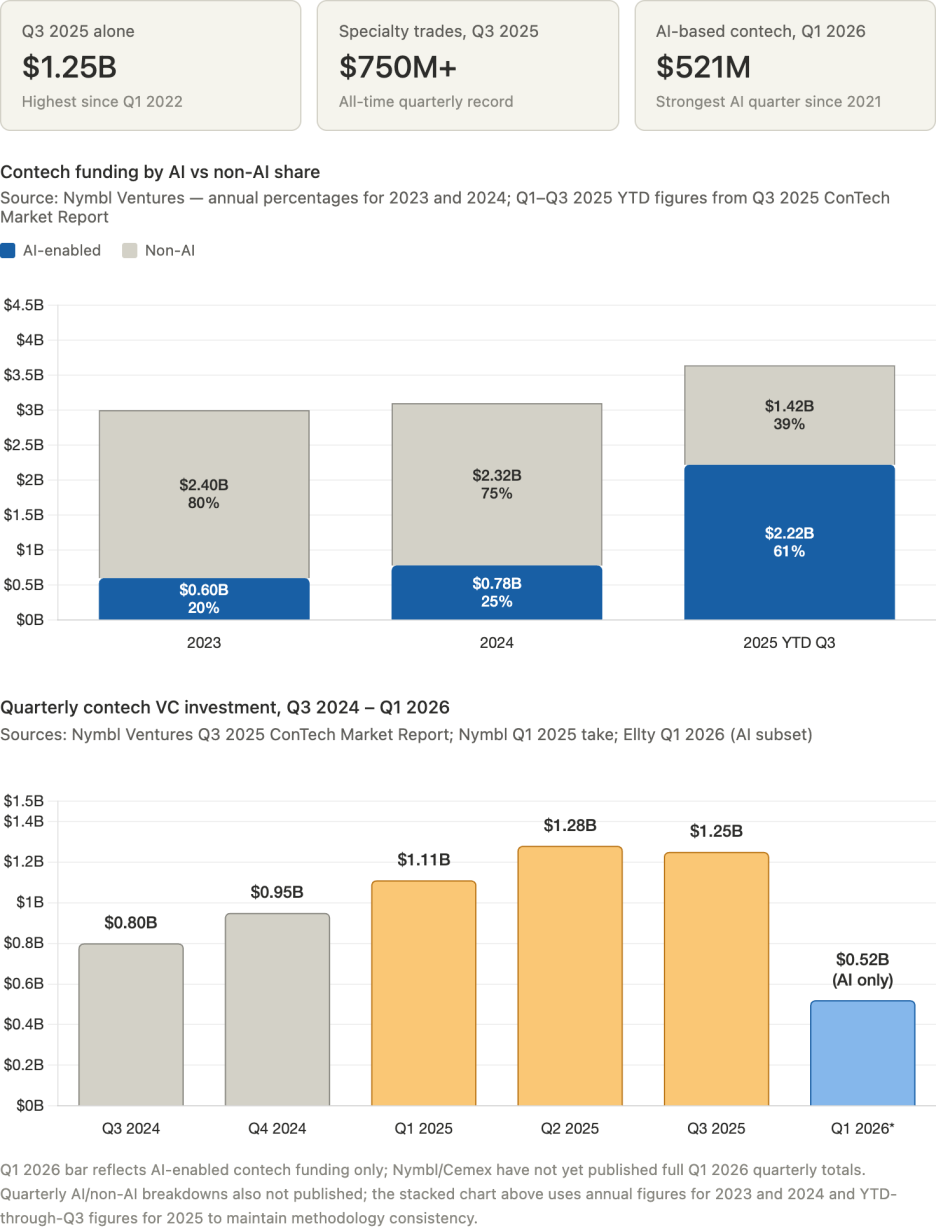
Contech is in its most active venture moment since 2021. Startups raised $3.7B through the first three quarters of 2025, more than double the same period in 2024, with $1.25B in Q3 alone. Full-year 2025 closed at approximately $6.57B across 337 deals globally, per Cemex Ventures' Top 50 Contech 2026 report.
Signal 1: the dollars have doubled
Quarterly momentum tells the story sharply. Q1 2025 contech funding hit $1.11B, a 46% year-over-year jump and 17% quarter-over-quarter from Q4 2024, per Nymbl Ventures. Q2 2025 reached $1.28B and Q3 2025 hit $1.25B. Both quarters set the highest contech funding levels since Q1 2022. The Momentum was carried into 2026: AI-enabled contech alone hit $521M in Q1 2026, the strongest AI quarter since 2021.
Signal 2: AI is taking the lion's share
The composition shift underneath the dollars matters even more: AI-enabled contech rose from under 20% of contech funding in 2023 to 25% in 2024, then to 61% through the first three quarters of 2025. That's a 3x relative share increase in 18 months. AI-enabled contech alone reached $2.22B by Q3 2025, already exceeding all of 2023's full-year contech funding combined. Non-AI contech funding shrank in absolute terms over the same period. Capital is moving into AI-native categories with clear wedges into labor replacement, workflow ownership, and money flow.
Signal 3: market is maturing past Seed
A third signal sits beneath the totals. Post-Series A deals captured 80% of Q3 2025 contech funding, up from 60% in 2024 and 53% in 2023. The market has matured. Investors are writing fewer first checks and bigger growth checks. For new founders, the bar at Seed and Series A is higher than ever. The validation pathway is also clearer, since there are now real Series B and C comps in nearly every category.
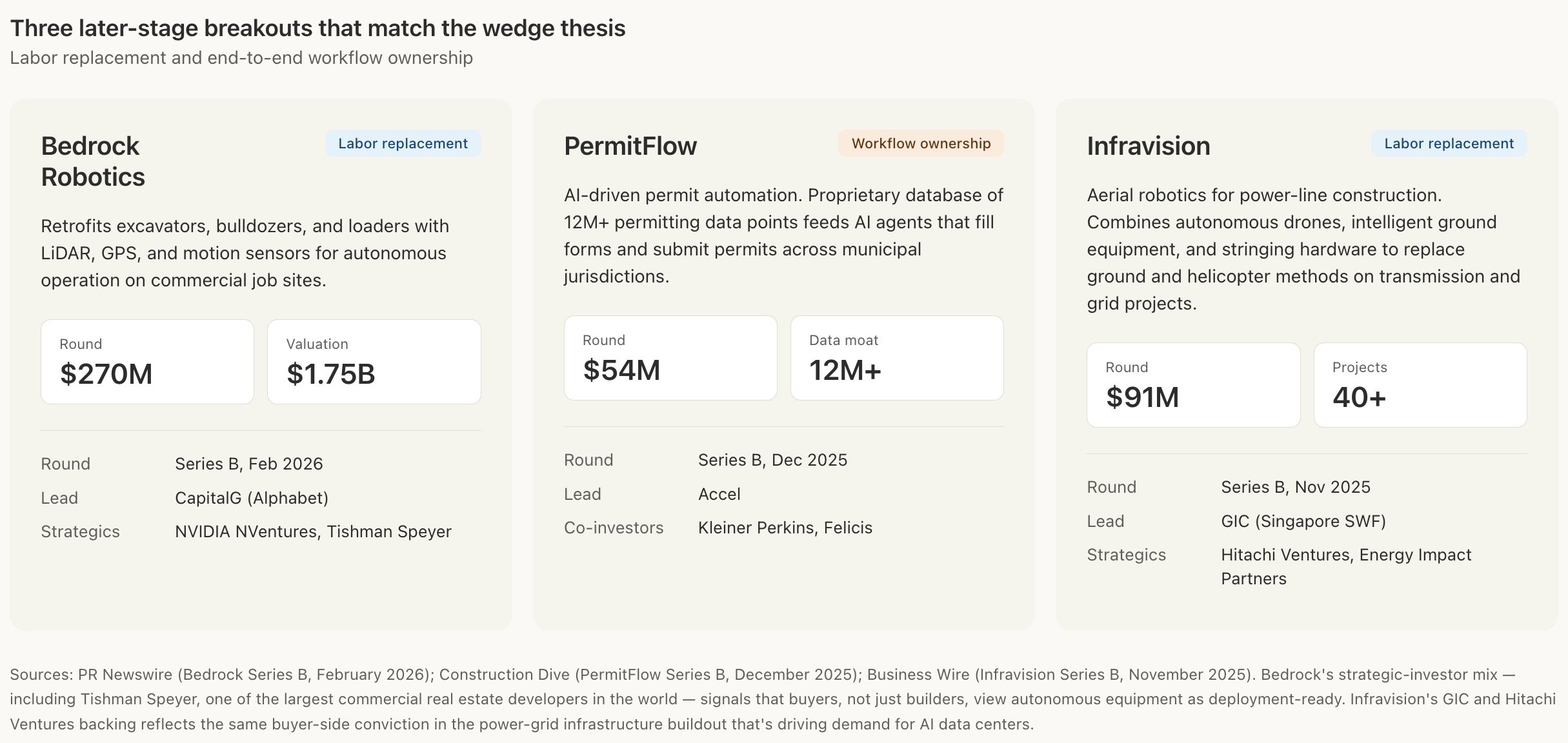
Recent later-stage breakouts make the wedge thesis concrete: capital is concentrating at later stages, around labor replacement and end-to-end workflow ownership, while horizontal SaaS plays continue to struggle.
- In February 2026, Bedrock Robotics raised $350M+ at a $1.75B valuation to retrofit excavators and bulldozers for autonomous operation. CapitalG led the round. Strategic capital came from NVIDIA's NVentures and Tishman Speyer, one of the largest commercial real estate developers in the world.
- Two months earlier, PermitFlow closed a $54M Series B led by Accel, bringing AI-driven permit automation into the same later-stage bracket on the strength of a 12M-permit data moat. * In March 2025, BuildOps crossed unicorn status with a $127M Series C for vertical software targeting commercial specialty trades.
- November 2025, Infravision raised $91M Series B led by GIC to scale aerial robotics for power-line construction, a labor-replacement bet riding the AI infrastructure buildout.
What hasn't changed: the structural constraints
The funding signals are new but the buyer's reality underneath is not. From years of building and screening products inside a general contractor, the same five constraints kept showing up. They are the reason most contech bets stall between Series A and B, and any founder entering the space should plan a wedge that works with them rather than past them.
- The buyer is fragmented. A single project has an owner, general contractors, subcontractors, designers, suppliers, and lenders, each with their own software and incentives.
- Margins are thin. General contractors and subcontractors run on 2–5% net margins. They will not pay SaaS prices for productivity gains they can't tie to revenue, recovered claims, or freed capital.
- Adoption is risk-averse. Pilots happen on the calmest projects. The ROI signal gets muted, and renewals become harder than they should be.
- The big two consolidated the boring middle. Procore and Autodesk own document control, RFIs (Request for Information), and submittals. Network effects from owner-mandated workflows make this layer extremely hard to disrupt directly.
- The data is mostly not digitized. Drawings live in PDFs and printouts, contracts and change orders live in email threads, daily reports live in field-completed paper forms, and tribal knowledge lives in retiring workers' heads. Founders building any AI product run into a cold-start problem that does not exist in industries with mature data infrastructure. Solving the data extraction problem is part of the wedge, not a precondition to it.
The frontier is downstream, at the specialty trades and subcontractors. They control 63% of the construction workforce and have been underserved by software for decades. Funding for that segment hit more than $750M in Q3 2025, the highest quarterly total ever recorded.
What Working Looks Like
Those numbers describe a market in motion. But aggregate funding tells you where capital is going, not where it's working. The best way to see what's working is to look at who actually made it to Series B and beyond.
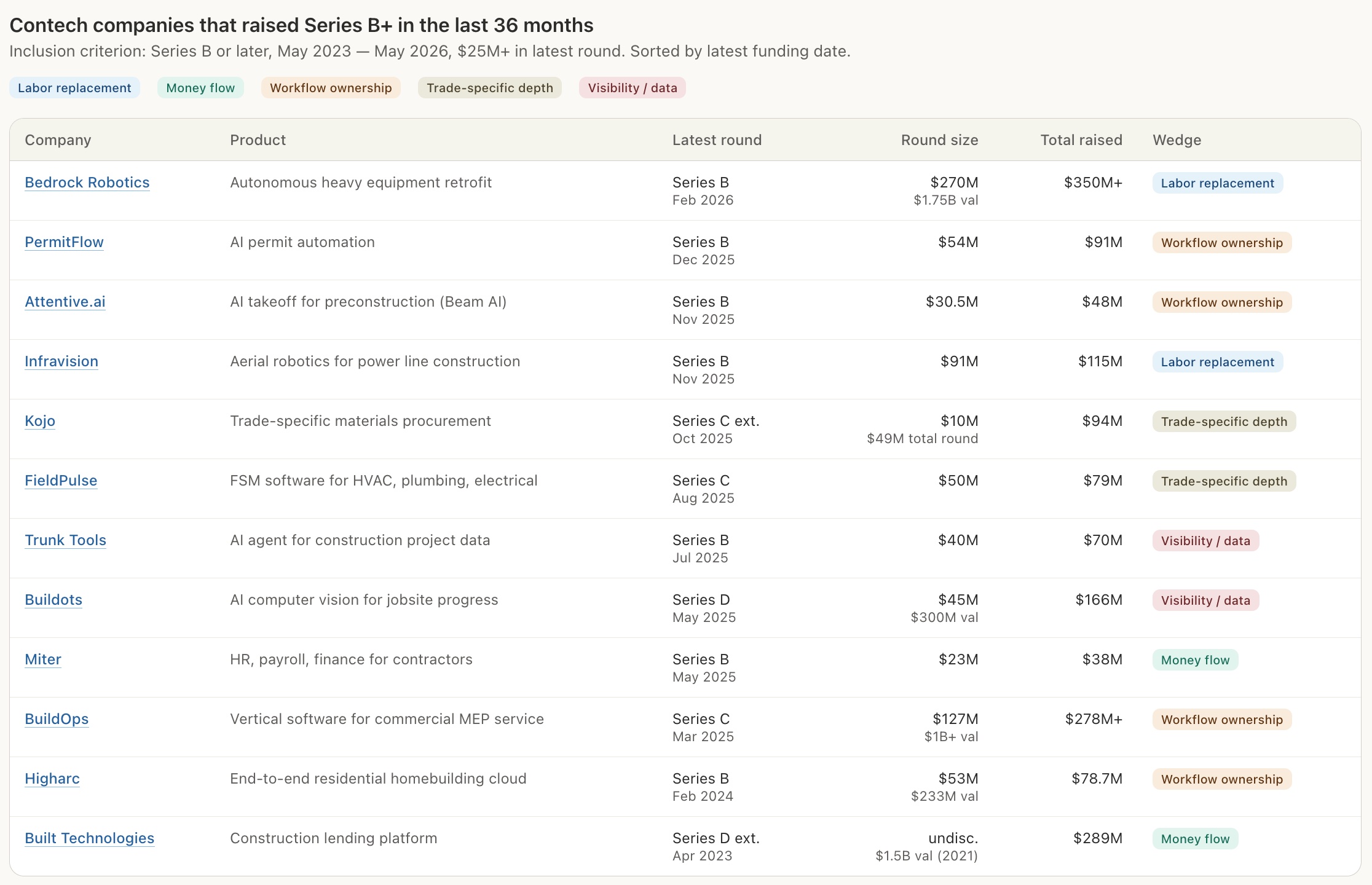
The table below includes every contech company that raised Series B or later in the last 36 months with at least $25M in its most recent round, sorted by latest funding date. Ten occupy one of the four wedge types I work through in Section 4: labor replacement (replacing a billable seat), money flow (touching the dollars), end-to-end workflow ownership (replacing a tool the buyer was using), and trade-specific depth (anchoring in one trade's full software stack). The other two are tagged visibility-only. The pattern is part of the analytical point.
A few things stand out in the data:
- 10 of the 12 companies sit in one of the four wedge shapes the article is arguing for, and the three largest valuations (Bedrock at $1.75B, Built Technologies at $1.5B, BuildOps at $1B+) span three different wedges (labor replacement, money flow, and workflow ownership). There is no single winning wedge. There are four winning shapes, each capable of producing unicorn outcomes. Section 4 walks through each in detail.
- The two companies outside the four-wedge framework, Buildots and Trunk Tools, are visibility/data overlays. Their products surface information about a workflow (Buildots via 360-degree cameras and computer vision, Trunk Tools via AI agents querying project documents) without owning, replacing, or financializing the work itself; the buyer still does the work in another system.
- Buildots reached Series D through aggressive enterprise execution, but its $300M valuation after five rounds is well below Bedrock's $1.75B at Series B.
- Trunk Tools is newer (Series B in July 2025, $70M total) and represents a different flavor of the same pattern — AI agents querying project data rather than camera-based jobsite tracking.
- Doxel, which raised a Series B in 2021, hasn't pursued external funding since but has gone deep into complex projects in data centers, healthcare, and life sciences. Whether agentic AI overlays like Trunk Tools can break through the structural cap that camera-based visibility hit is worth watching.
- Wedge-tagged companies cluster in the top of the table because they raised most recently. Visibility-only companies sit at the bottom. Wedge shape predicts both who is still in the market and how much capital they can compound.
The Structural Reality of the Construction Industry
The PMF table shows what winning looks like from the outside. But it doesn't capture the structural reality that determines whether a product gets to that table. If you spend a week in a GC's main office or on a jobsite, you will find out contech is more than just a software story.
The labor shortage is the single most-cited cause of project delays in the industry, and it is not a bad year. It is a structural workforce shift driven by demographics that will deepen through 2031 and beyond.
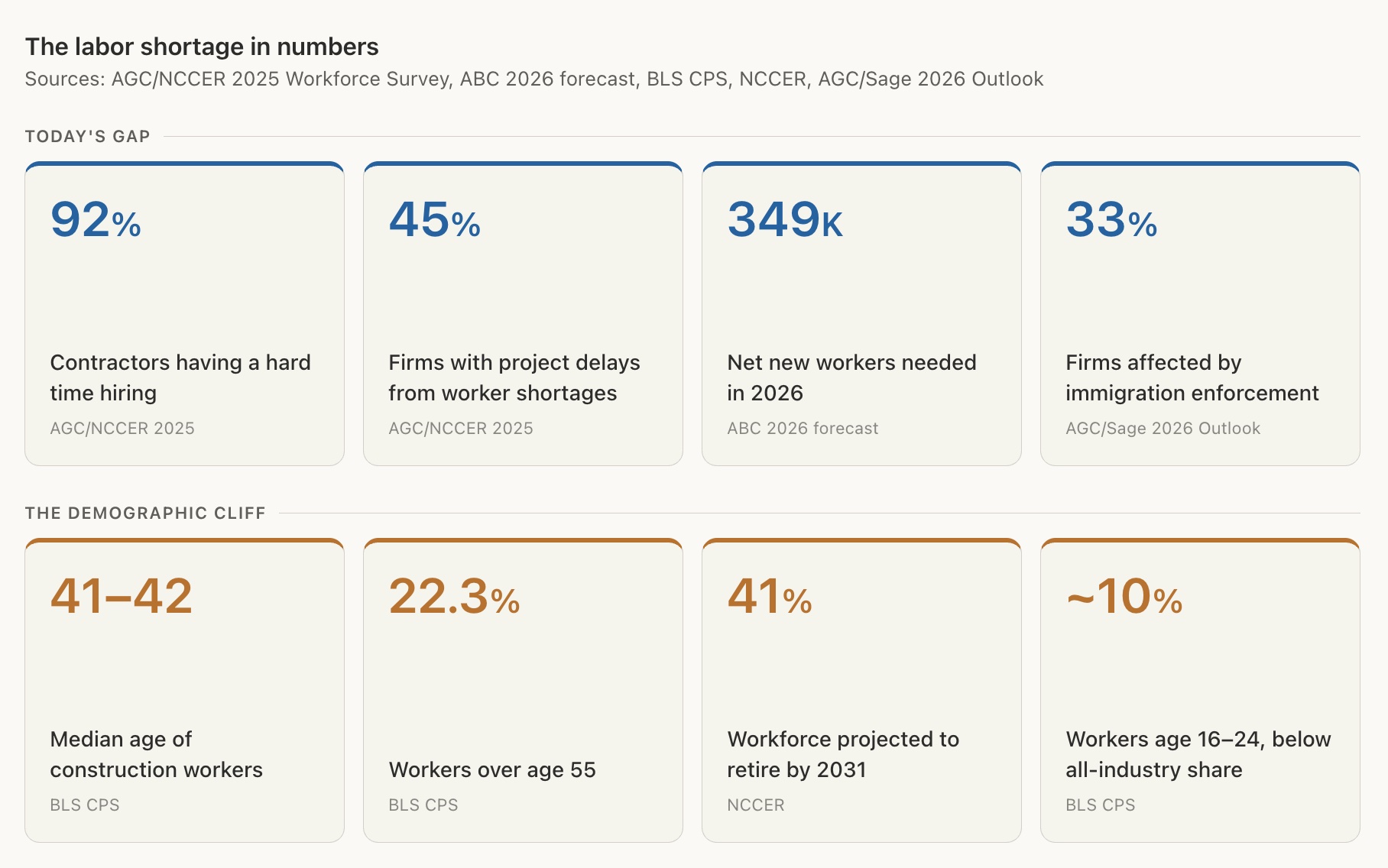
What the data describes in aggregate, you can see on any jobsite as a generational split. Veteran project managers, superintendents, and estimators in their 50s and 60s carry tribal knowledge in spreadsheets, mental models, and personal relationships with subcontractors. Engineering school graduates entering the industry expect software-as-a-default but rotate out within two to three years because the work doesn't match what their tools or training led them to expect.
The gap shows up everywhere:
- A young scheduler builds a Critical Path Method (CPM) schedule in Oracle Primavera P6 that mathematically balances. The superintendent laughs at it because the actual sequencing depends on which sub has crew availability that month, something the schedule doesn't model. The schedule becomes a deliverable for the owner, not a tool for running the job.
- A new estimator runs takeoff in software. The veteran overlays a "factor" that comes from twelve years of seeing the same drawing types come in 18% over the model. That factor is undocumented and walks out the door at retirement.
- A young project manager treats the contract as the source of truth. The veteran knows the contract is what gets argued about in a claim, while the actual project runs on relationships — which sub is reasonable, which one escalates, which one pays on time.
This is the texture you can only get from talking to people, and it points at the most common founder mistake: designing for the younger generation's mental model when the buyer and the user are someone else entirely. This is the people gap. Products that depend on the young engineer adopting them, or that try to digitize what the veteran carries in their head, run into the same wall: behavior change at scale across a workforce that is shrinking, aging, and turning over.
The data gap is the people gap on disk. Drawings live in PDFs and printouts because the supers and PMs using them prefer paper on a chaotic jobsite. Daily reports stay on field-completed paper forms or in photos on personal phones because the field crews filling them out didn't grow up writing things down digitally. Tribal knowledge lives in workers' heads because the people carrying it never had a reason to put it elsewhere. Founders who plan to consume existing construction data as a wedge will discover it doesn't exist in usable form. Solving the data extraction problem is part of the wedge, not a precondition to it.
Here is a tactical suggestion: interview recent construction engineering grads in their first six months on the job, and pair those conversations with retiring superintendents and estimators. The gap between what new grads expected and what veterans are about to take with them is the richest source of product insight in this industry.
Where the Wedges Are
The structural reality of the construction industry is what determines whether a contech product can scale. The wedges that win are designed around it.
- They don't ask veterans to change behavior. Instead, they create value that the buyer has no incentive to resist: the seat is being replaced, the company is being paid faster, the workflow is being owned end-to-end, or the trade is being served end-to-end with software the GC never sees.
- They don't depend on data that doesn't exist in usable form. Instead, they generate clean data as a byproduct of operating the workflow (PermitFlow's permit submissions, Miter's payroll workflow), bring their own sensors (Bedrock's LiDAR, Doxel's cameras), or replace data-handling tasks outright with AI agents (Togal's takeoff).
Four wedges carry pricing power
The winning wedges are not workflow domains but patterns in how a product captures value, cutting across estimating, scheduling, procurement, payments, and field operations alike. Each is a category where a new founder with the right wedge can build a venture-scale company.
A founder who picks a wedge first and a workflow domain second will outperform a founder who does the reverse.
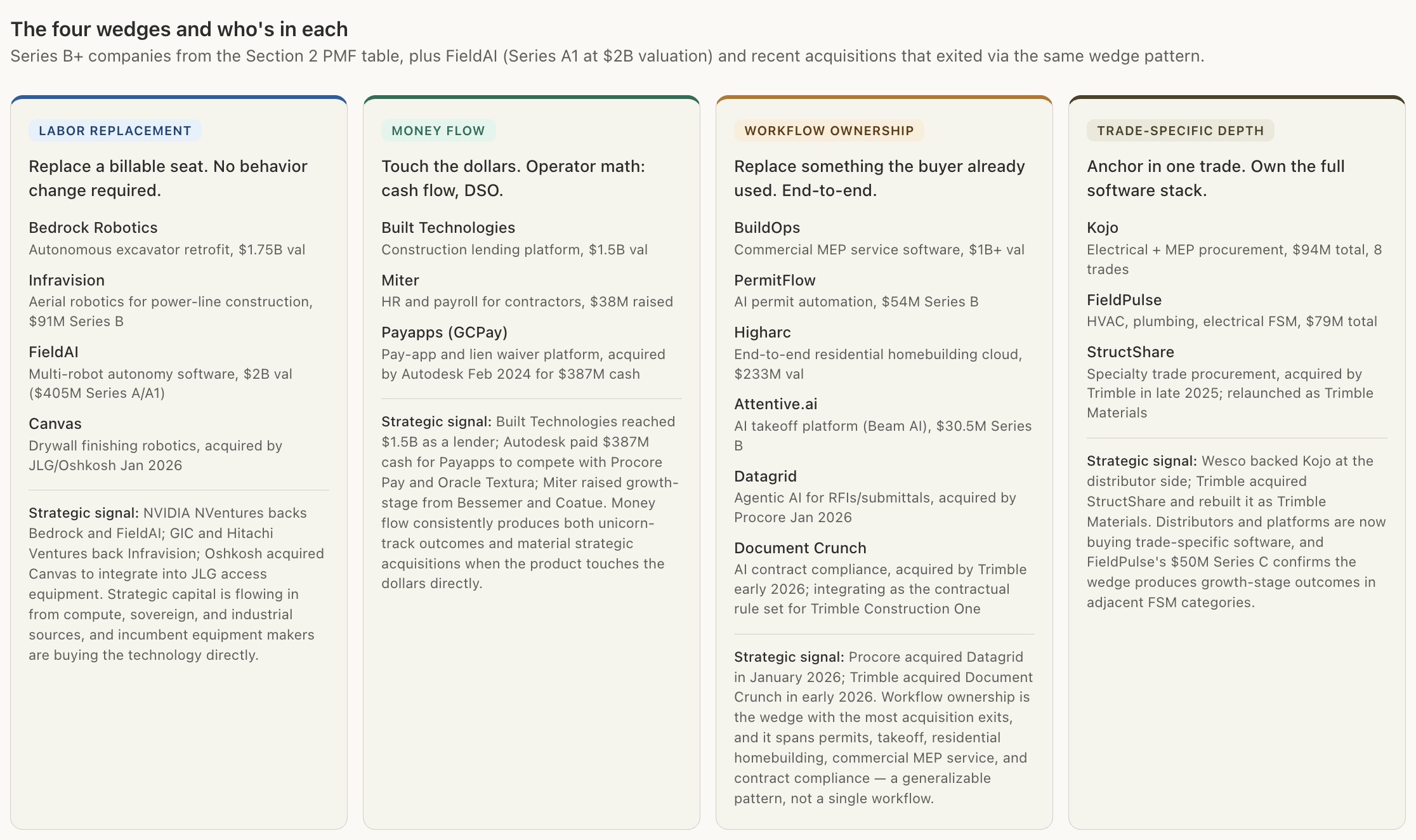
Labor replacement
The wedge: Replace a billable seat with a machine or an agent. The buyer subtracts the labor cost, adds the software cost, and pockets the difference. There is no attribution debate, no behavior change required, and no internal champion needed because the seat being replaced does not get a vote.
Why it's working now: Labor replacement is the highest-momentum wedge in contech. Robotics captured 37% of all contech funding YTD through Q3 2025, up 125% year-over-year, and heavy equipment automation alone delivered $684M across seven deals. Two recent rounds anchor the magnitude: Bedrock Robotics raised $270M in Series B at a $1.75B valuation, purpose-built for construction equipment retrofit; FieldAI raised $405M across consecutive Series A and A1 rounds at a $2B valuation as a horizontal autonomy platform that includes construction alongside energy, mining, and federal applications. Both signal that labor-replacement bets are attracting capital at scales previously reserved for late-stage SaaS.
Where the opportunity is:
- Trade-specific labor replacement for drywall, MEP rough-in, finish carpentry, and glazing remains underserved. Each trade has its own ergonomics, tool kits, and unionization patterns, and horizontal robotics doesn't capture that depth.
- Operator augmentation can be sold before full autonomy. Many contractors aren't ready for unmanned equipment, but they will pay for tools that let one operator run two or three machines.
Money flow
The wedge: Touch the dollars. A money-flow product moves capital faster (billing, payments, lien waivers), finances it earlier (invoice factoring, project lending), or de-risks it (insurance, surety, change order management). The buyer math is operator math: cash flow, days sales outstanding, working capital. Every CFO in construction wakes up thinking about these numbers.
Why it's working now: This is the highest-urgency wedge in contech. Subcontractors wait an average of 96 days for payment. Slow payments cost the industry $280B in 2024, and the share of subs using retirement savings as working capital is up 147% since 2019. That last data point tells you everything about how broken this is. The major contech platforms are racing to own the wedge: Autodesk paid $387M cash for Payapps in February 2024 to bring pay-app submission and lien waiver into Autodesk Construction Cloud, joining Procore (which acquired Levelset in 2021 and launched Procore Pay in 2023) and Oracle (which has owned Textura since 2016). Money-flow products attract financial-services-style multiples because revenue scales with transaction volume rather than seat count, which is why this wedge consistently produces both unicorn-track outcomes and material strategic acquisitions.
Where the opportunity is:
- Lower-tier subs and specialty trades are largely unserved. Existing players target commercial subs in the $5M–$100M revenue range, while the long tail still runs on QuickBooks plus spreadsheets.
- Owner-direct pay rails remain wide open. Most products sit at the GC-to-sub interface, but the owner-to-GC interface is still wire transfer, paper checks, and bank-portal logins.
- Working capital products built into the billing workflow are nascent. Invoice factoring, project-based lending, and embedded finance are the shapes that fit.
End-to-end workflow ownership
The wedge: Own a workflow from start to finish. Workflow ownership is about owning a software workflow end-to-end so the buyer stops using the previous tool. The test is replacement rather than augmentation: when your product is live, does the buyer stop using something else? If yes, you own the workflow. If they still run Procore, P6, and Excel alongside your tool, you are augmenting.
Why it's working now: AI agents can now do work that previously required human attention, which means a software product can credibly own an entire workflow rather than generate data for a human to act on. PermitFlow's agents fill municipal permit forms autonomously, Attentive.ai's Beam AI does takeoff end-to-end, and BuildOps replaces six legacy tools for commercial specialty trades. The market is also rewarding this with M&A: Procore acquired Datagrid in January 2026 for its agentic AI on RFIs and submittals,, and Trimble acquired Document Crunch in early 2026 to serve as the contractual rule set for Trimble Construction One. When a workflow-ownership product does work the dominant platform cannot replicate organically, the dominant platform buys it.
Where the opportunity is:
- Bid-to-close loop ownership is open. The wedge is not faster takeoff but higher win rate. Founders who connect takeoff to bid strategy and historical win/loss data own a more valuable seat than the takeoff vendors.
- Owner-side contract compliance is wide open. Owners want to know if their GCs and subs are conforming to contract requirements in real time, and almost no one does this well today.
Trade-specific depth
The wedge: Anchor in one trade vertical and own its full software stack: assemblies, labor productivity rates, supplier ecosystems, takeoff logic, billing workflows, and field operations specific to that trade. Horizontal contech cannot reach this depth without becoming a worse product. Trade veterans recognize when a product was built for them rather than translated from a horizontal one, and they buy accordingly.
Why it's working now: Specialty trades and subs received more than $750M in Q3 2025 alone, the highest quarterly funding ever recorded for that segment. The trades control 63% of the construction workforce and have been underserved for decades. Procore and Autodesk built for GCs. The trades got crumbs.
Where the opportunity is:
- Most specialty trades still lack purpose-built procurement software. Kojo serves electrical and is expanding to mechanical and plumbing, but flooring, roofing, glazing, and finishes each have their own supplier ecosystems, and almost none have been digitized.
- Distributor-side software is a real opportunity. Most procurement tooling has been built for the buyer, while the supplier side is still phone, fax, and email. The Kojo–Wesco partnership shows distributors are now willing to pay for it.
The shape of strategic capital
An early pattern worth watching: each wedge appears to attract a distinctively different shape of strategic capital.
- Labor replacement attracts three different shapes: compute-thesis investors at platform level (NVIDIA NVentures backed both Bedrock and FieldAI), sovereign wealth and industrial strategics at trade level (GIC and Hitachi Ventures backed Infravision), and direct acquisitions by incumbent equipment makers (Oshkosh's JLG division acquired Canvas in January 2026 to integrate drywall robotics into its access equipment).
- Money flow produces both unicorn-track outcomes through growth investors (Built Technologies at $1.5B, Miter from Bessemer and Coatue) and material strategic acquisitions (Autodesk paid $387M cash for Payapps in February 2024 to compete with Procore Pay and Oracle Textura).
- Workflow ownership has produced the most acquisition exits in the dataset: Procore acquired Datagrid in January 2026 and Trimble acquired Document Crunch in early 2026, with two of the four major contech platforms making workflow-ownership acquisitions in a six-month span.
- Trade-specific depth draws both distributor partnerships (Wesco–Kojo) and platform acquisitions (Trimble acquired StructShare).
The data points are sparse, but the directional read is worth taking seriously: a founder picking a wedge is also, plausibly, picking the kind of strategic capital they will eventually receive.
A cautionary tale: visibility vs. labor replacement
Buildots and Doxel both started in AI computer vision for jobsite progress tracking, both raised Series Bs in 2021, and both use the same hardware: 360-degree cameras on hardhats, comparing imagery to the BIM model across 80+ construction stages. They've since pursued visibly different strategies.
- Buildots built two-way integrations with Procore, Autodesk, and the schedule-of-record tools GCs run their projects in — Primavera P6, MSProject, Asta Power Project — auto-writing progress back into those schedules, turning a visibility tool into a system that updates the master schedule.
- Doxel chose vertical depth, focusing publicly on data centers and complex projects (Stream Data Centers, hyperscaler-ready facilities, healthcare clients like Genentech and HCA), with a relationship-led GTM and a service-based integration model rather than self-serve APIs.
- The two companies are essentially testing different theories of how to compound capital in a structurally hard category. Buildots has bet on horizontal integration depth and reached Series D at roughly $300M valuation, $166M raised; Doxel has not raised externally since August 2021, pursuing capital efficiency over fundraising momentum.
Both Buildots and Doxel are running coherent strategies. Buildots toward category-leading scale via horizontal integration, Doxel toward vertical depth and capital efficiency. The deeper comparison is between visibility-rooted products as a category and labor-replacement products as a category. The best-executed visibility play in this category took five years and four rounds to approach $300M valuation. Bedrock Robotics, anchored in the labor-replacement wedge, reached $1.75B at Series B in 18 months.
Visibility products augment workflows that supers and project managers still own, so the buyer math depends on attribution and behavior change. Labor replacement removes the seat, and the buyer math is unambiguous. Investors price the difference. In contech, observation is a feature, not a moat. Even the most deeply integrated visibility product compounds capital slower than a product that replaces the worker.
Funding as goal vs. funding as input
Before picking a wedge, founders have a prior choice: is the goal a fundable company or a sustainable one? Both have precedent in this market: Buildots has bet on category-leading scale via repeat fundraising; Doxel has gone deep on vertical depth without raising externally since 2021. The product roadmap, hiring decisions, and customer selection all look different depending on the choice. Make it consciously and early.
Where I'd pass
- Another horizontal SaaS layer competing with Procore or Autodesk: The big two own document control through owner-mandated workflows; head-on competition burns capital trying to displace network effects.
- "AI for [workflow]" with no path into procurement budget or money flow: Productivity tooling without a hard ROI line falls into the discretionary budget that gets cut first when projects tighten.
- Field tools that depend on superintendents changing behavior at scale: The workforce is shrinking, aging, and turning over. Even if pilot projects work, field teams quietly stop using the tool on the next job.
- Visibility-only products that augment observation without owning the workflow they observe: Buyers can't cleanly attribute outcomes to the product, so ROI stays fuzzy and capital compounds slower than in wedges that replace the work.
- Productivity dashboards aimed at PMs and owners that require manual input from the field: The data never arrives clean — supers don't input what they don't get paid to input, and the dashboard ends up displaying stale or fabricated numbers.
Where to Sell: ICPs for New Contech Founders
Picking the right wedge is half the equation. The other half is choosing the right Ideal Customer Profiles (ICPs) to sell to first. In construction, the wrong initial customer doesn't just slow you down — it can permanently anchor your product to a use case that won't scale. The buyer landscape is fragmented across very different procurement behaviors and budgets. The four buyer profiles below are ranked by how readily they convert into early customers, not by how much money they ultimately spend.
Best initial ICP: mid-market specialty trades and subcontractors ($10M–$200M revenue). These companies feel software pain acutely but have enough scale to have a real software budget. The decision-maker is usually the owner-operator, CFO, or VP of operations. Sales cycle is 30-90 days. They will pilot, give honest feedback, and roll a product out across their organization quickly if it works. Miter, Kojo, Attentive.ai, and FieldPulse all built early traction here.
Second ICP: mid-market GCs ($100M–$1B revenue). IT capacity and software budget without the procurement and security review processes of the top 50 ENR firms. Often the design partners and reference customers for breakout contech companies. Suffolk (Kojo, Higharc), Coastal Construction (Togal), and similar regional powerhouses repeatedly show up as both early customers and strategic investors.
Third ICP, only after traction: large GCs and ENR Top 50. Long sales cycles (12-18 months), complex security and procurement reviews, multi-division stakeholder alignment. Worth pursuing for logo value and contract size, but a poor place to start. Founders who aim here first usually run out of runway in pilot purgatory.
Fourth ICP, wedge-dependent: owners and developers. For labor replacement and end-to-end workflow ownership wedges, owner-side buyers are increasingly relevant. Tishman Speyer's strategic capital in Bedrock Robotics is a signal: the largest commercial real estate developers in the world are starting to buy their own contech. Owner buyers have longer cycles than mid-market subs but vastly more budget per project.
Avoid as initial ICPs:
- Small contractors (<$10M revenue, no software budget).
- Public-sector buyers (procurement cycles measured in years).
- Owners and developers without active project pipelines (they say yes to demos and disappear when it's time to deploy).
Distribution shortcuts that work.
- Trade associations are an underrated distribution channel. The two largest cover GCs and broad subs (Associated Builders and Contractors, Associated General Contractors); specialty groups serve individual trades (electrical via NECA, mechanical via MCAA, sheet metal via SMACNA). Email lists, conferences, Tech Alliance programs (Kojo's playbook).
- Strategic distributor partnerships: Wesco, Ferguson, Sonepar control distribution into the trades. Co-development deals are a real GTM lever.
- Construction-specific funds and CVC arms: Cemex Ventures, Suffolk Technologies, Brick & Mortar Ventures, Building Ventures, Foundamental, Zacua, Ironspring. They invest, but more importantly they make customer introductions.
Closing
Contech is no longer a contrarian bet. The capital is there, the breakout pattern is clear, and there's real urgency from AI, labor shortages, and tariff volatility creating buyer pull. But the bar for new founders is higher than ever, and the wedges that win are narrow.
If you're entering this space, spend the time with operators before you spend the time with investors. The best wedges in contech come from someone who has watched a CFO cry over a 96-day-old receivable, or seen an estimator hand a job to a competitor because they couldn't get the bid out in time. Those moments are where real products start.